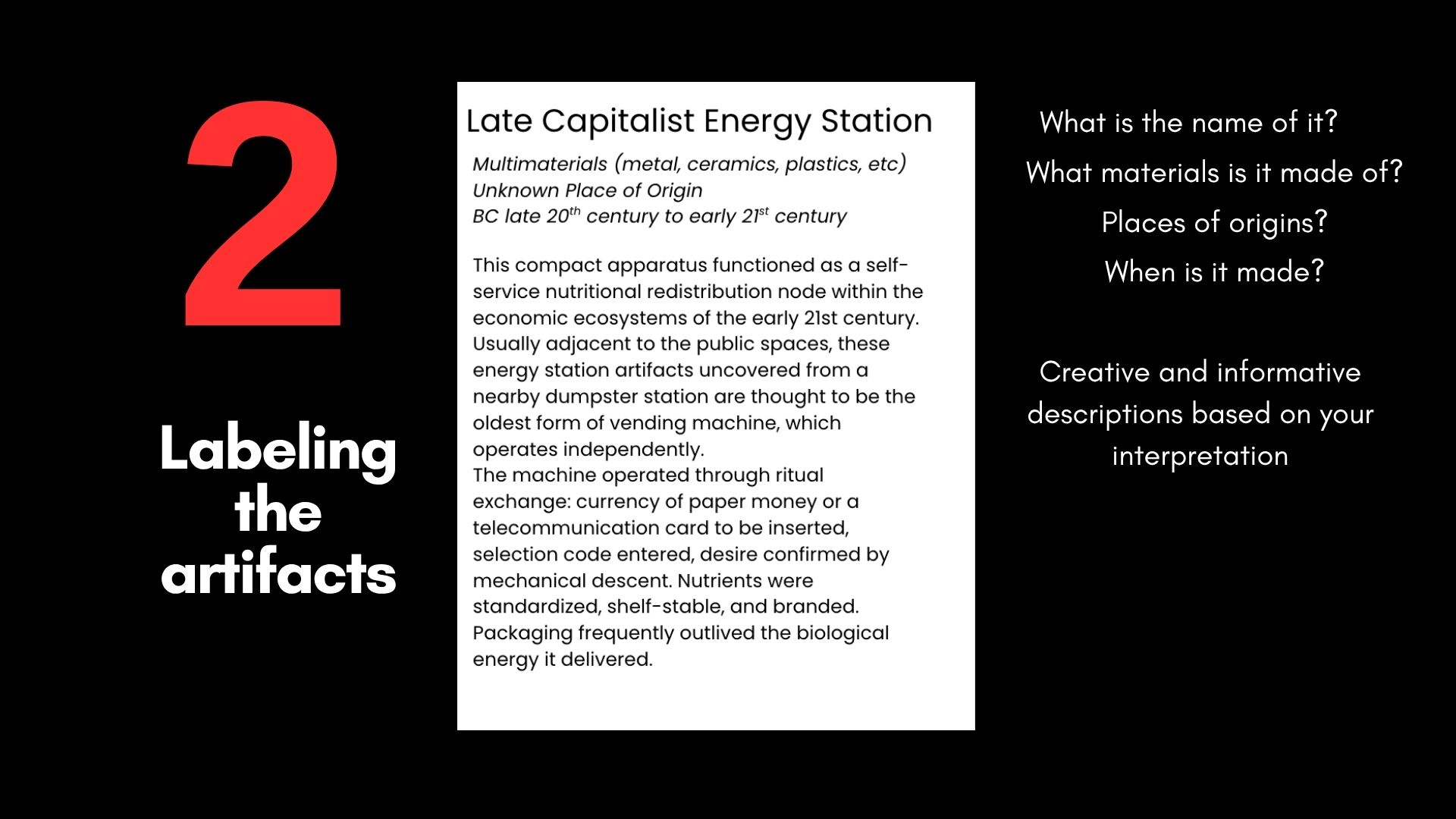
The performance asks what it means to remember—and misremember—our own time from the vantage point of an imagined future. Its purpose is to stage the present as a ruin: to treat everyday objects, habits, and media as archaeological fragments that expose how colonialism, capitalism, climate catastrophe, and gendered violence are woven into ordinary life. By using a museum guide that glitches, misreads artifacts, and fails to reconstruct a “complete” history, the piece questions who holds the archive, whose stories are lost, and why fantasies of perfect technological memory are themselves violent and incomplete. At the same time, the work invites audiences to become active participants rather than passive spectators: through the excavation and interpretation, they help build an evolving, collective archive that acknowledges gaps, errors, and silences. The performance ultimately aims to unsettle institutional authority of the museum and professional narratives, foreground invisible and marginalized knowledges, and open space to imagine different futures from the ruins of the present.
The performance, driven by a methodology that I call “critical bullshitting”, is meant to provoke thoughts from you, the audience, to co-performatively write history from a future perspective, as well as reflect on these questions:
How do we write history?
And what is the future we are going into?
If there is any…
From my early childhood, I have been fascinating about museum and archaeology because of a documentary series in China, called Archaeological Findings 考古发现. I would spend a lot of evenings watching this documentary series with my mom to see how archaeologists trying to make sense of the findings they got, and to whom they belong to.
This has left me with a very deep impression on how history remembers and misremembers. Especially in the institutions of museums, where all the archaeological findings would eventually end up. As what Foucault would call “heterotopia(other places)”, I am fascinated by the idea of the temptation to accumulate all time and styles, striving to create a totalizing, organized space.
Whenever I go to the museum with my parents, my dad would easily dismiss all the artifacts in the museum as “it’s just a bottle”.
Yes. It’s kind of true.
But what is fascinating here is that how something that is mundane, normal, common, and even disposable can become the traces and evidence for us to make sense of what has happened. To a larger extent, does it really reflect what it truly means?
This has come to this project of performance, which initially started with an idea of a tomb tour or myself, but ended up in a more fantastical, imaginative, and fictional institution of the museum. I have many things that I want to tease with, and I feel the urge to not do it alone, but with everyone, including the audiences.
How does history becomes itself?
How do we understand history?
If we can understand it wrong…
In academic writing, the urge for knowledge production usually encourages us to pursue the truth. To consider it performatively, I want to create this multi-layeredness in narratives, to consider the present from the future intelligences(or humans or maybe not) to look at the contemporaries.
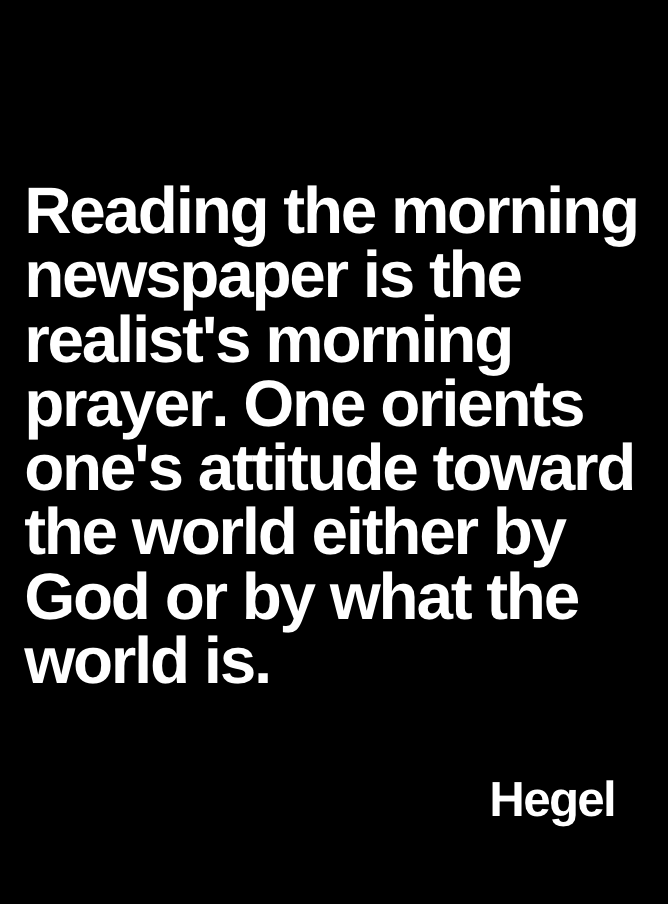
Shall we consider AI as the praying actions, if to replace Hegelian critique on the realist reading newspaper?
This is a question that I don’t have an answer.
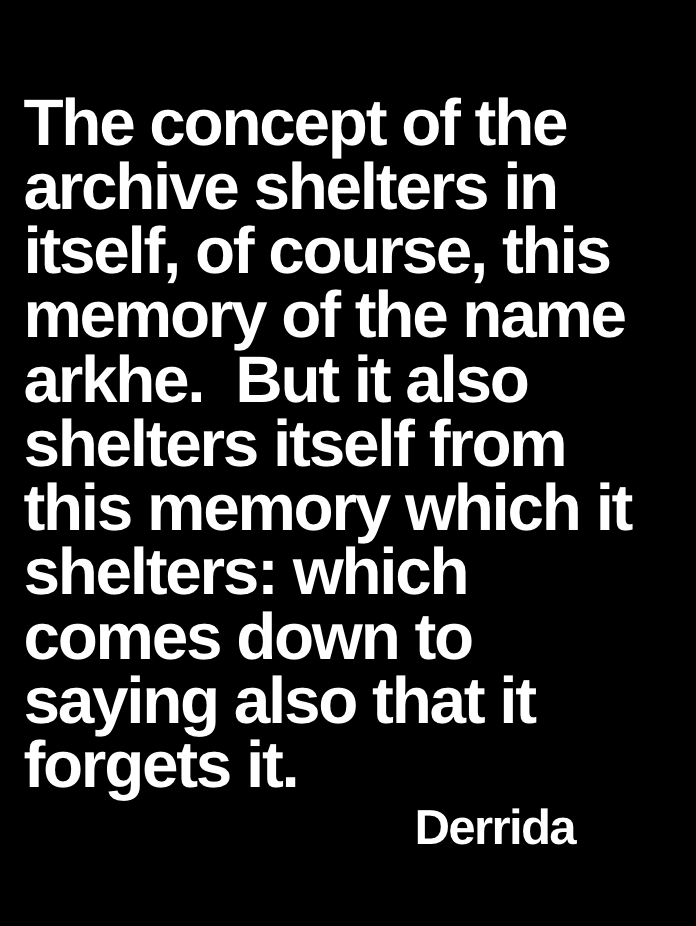
As many theorists including performance studies scholars, have theorized archives (and repertoire), the urge to preserve parallels with the urge of forgetting, disposals, gaps, and nonlinearity, which are integral part of our society.
In a famous article central to museum studies, Douglass Crimp’s On the Museum’s Ruins, he traces back to the history of the museum in relation to the process of decay and death, in the materiality of artifacts, as well as modernism, as well as the mass productions enabled by photography, making such “knowledge preservation” untrustworthy and valueless.
To posit such conversations in contemporary age, where all the digital data claims to have a sense of immortality which resists death, what does it mean for them to die? To haunt? If the materiality of their hard drives is faded and been destroyed?
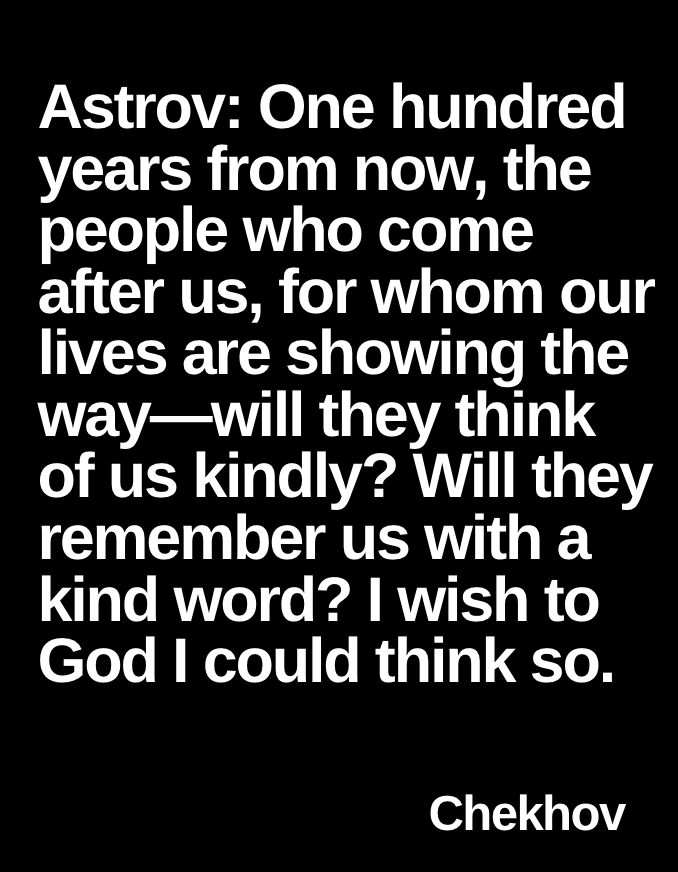
This quote is one of my favourite quote from Chekhov’s play which I am always suspicious of if this is not addressed to the characters, but from him, Chekhov, to us.
As a metatheatrical quote, I extend this to the question in the ending of the performance: what are your wishes for the future generation.
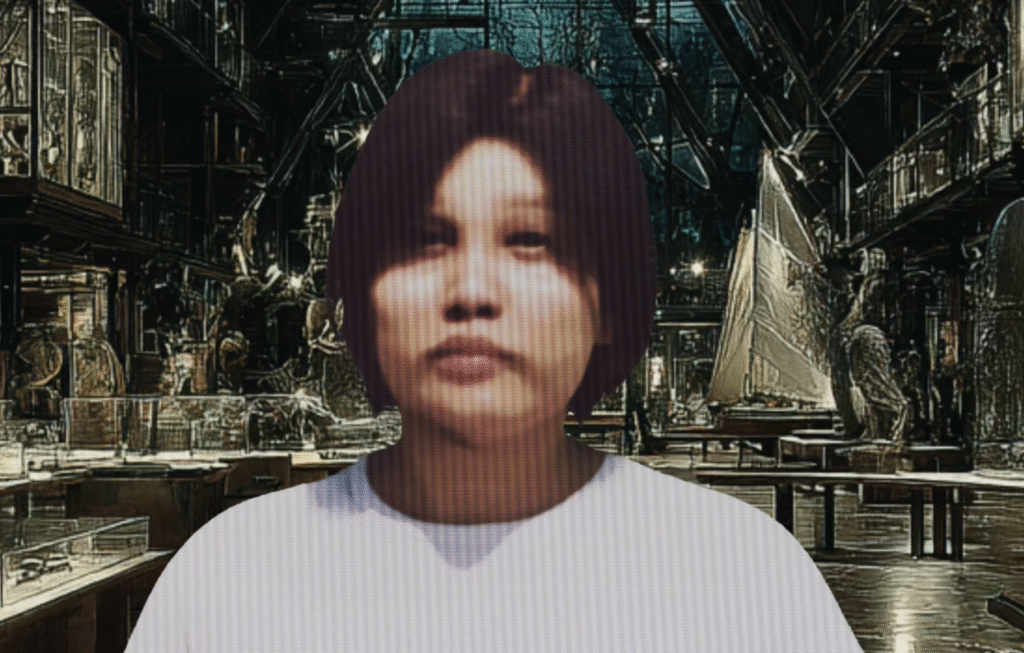
Yejia, the digital avatar, is a metahuman character I created with Unreal Engine. There might be easier ways to do it with AI but I found a great pleasure in creating this by 3D scanning my face and upload it t game engine and blender to create it.
As you may notice, the character’s face doesn’t resemble my face to the full extent, which is also something I discovered along this journey with game engine:
The Game Engine Design is based on a racist, colonialist reading of facial expression and 3D construction.
The tools of metahuman clearly don’t understand how my face works and how my facial expression works, which function on the default white face setting, despite its multi-metahuman characters of People of Color it included.
To create this character lead me on a journey to reflect on technology and art: what does it mean to have a digital avatar to perform for you? What does art mean when it’s mediated by technology? Is this still a performance when I am absent from the room?
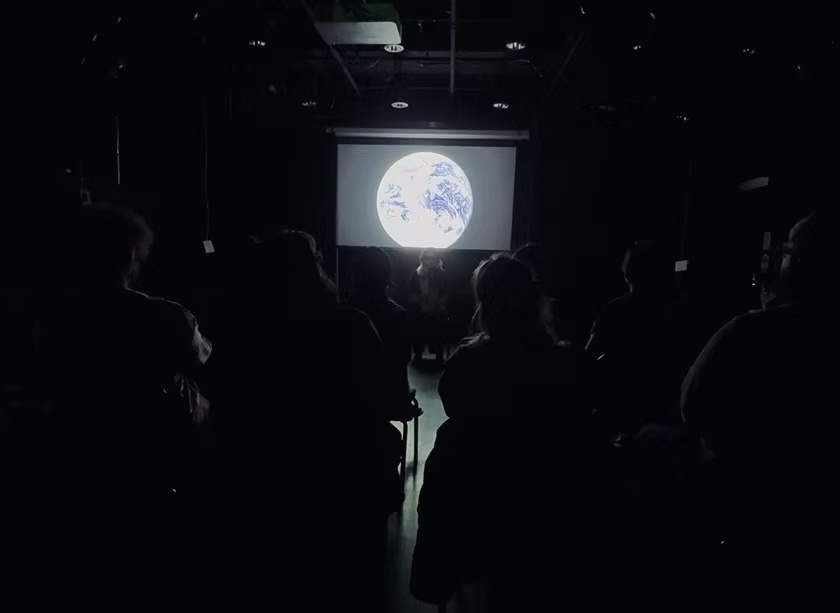
During the performance, the audiences will be asked to take on the role of future intelligences visiting the Museum of the 21st Century. The audiences will be welcomed as honored guests and guided through an unfolding experiment—an excavation of time, memory, and data.
The audiences will be invited to imagine a past era marked by a crisis of memory, when overwhelming data production and limited archival capacity led to widespread cultural loss. As participants, the audiences will encounter a reconstructed ancient gathering site known as a “theatre,” where humans once assembled to collectively suspend disbelief and trust in performance.
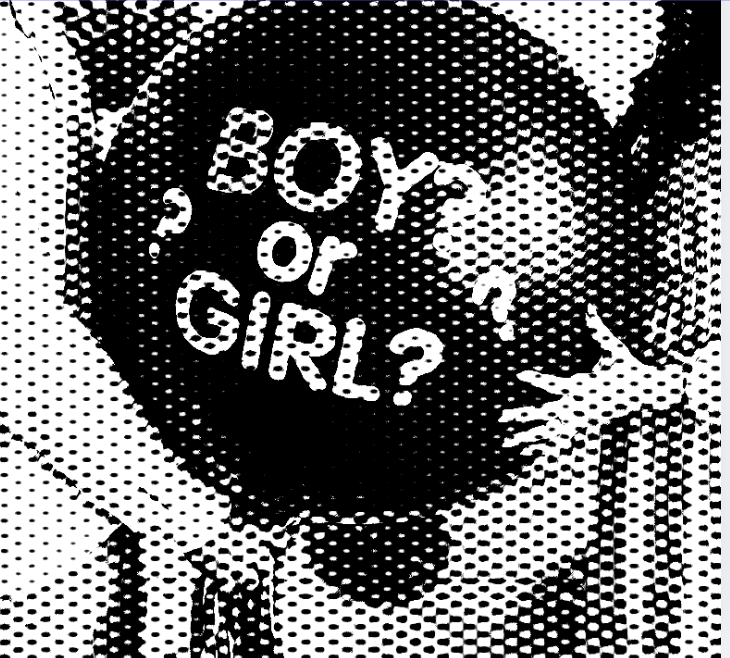
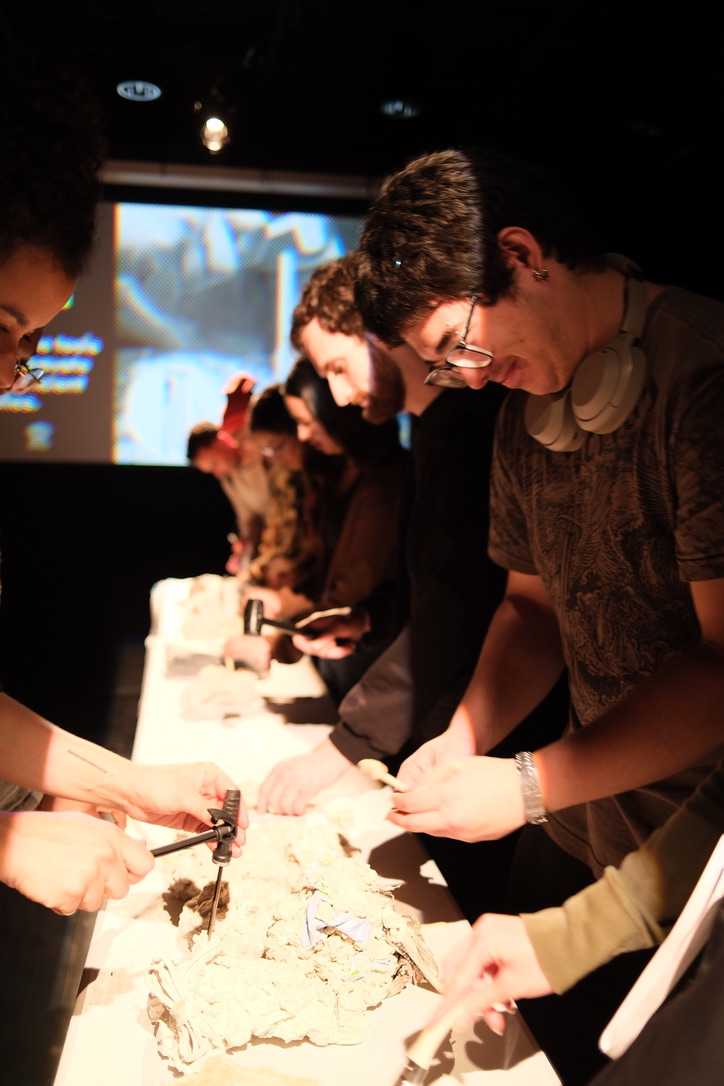
At the center of the space, the audiences will be asked to examine a set of fragile artifacts recovered from an excavation site in what was once New York City. Though incomplete, these objects will serve as prompts for the audiences to speculate on how people of that time lived, imagined, and remembered.
Drawing on Derrida’s notion that the archive is both a site of preservation and exclusion, the audiences will be encouraged to reflect on the power structures that shaped what was remembered and what was forgotten, and how these tensions contributed to the collapse of earlier museum forms.
As the audiences engage with the excavation sites in front of them, they will be asked to actively participate in reconstructing meaning. The audiences should consider what these artifacts might have been, what they meant to those who used them, and why they may have disappeared from memory. The audiences may also consult the guided tour and upcoming exhibition materials to help situate and categorize their findings within the Museum’s evolving archive.